
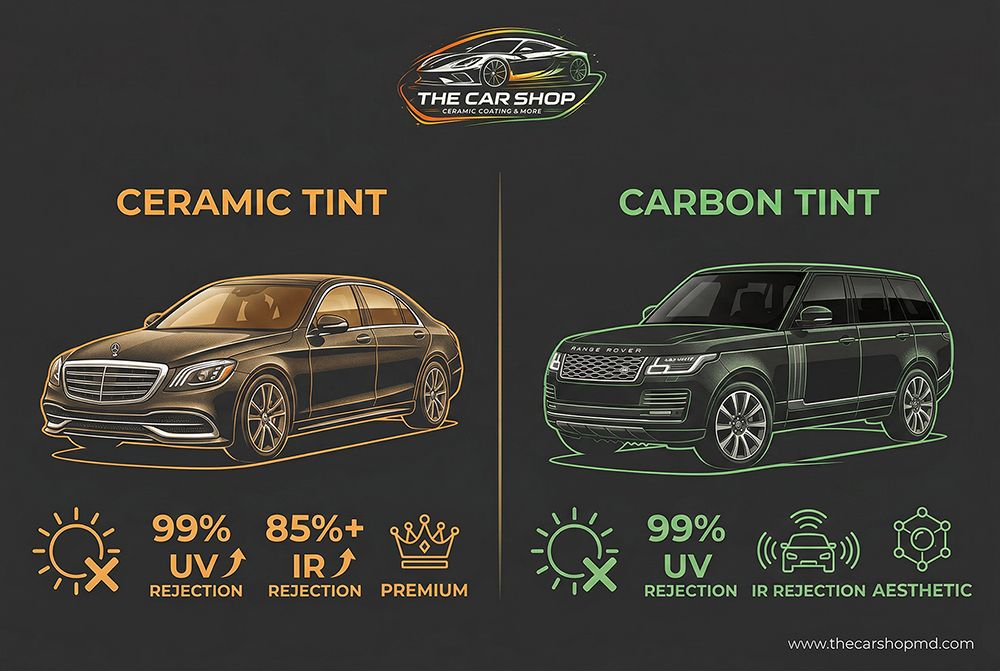

- Ceramic tint blocks significantly more infrared heat than carbon tint — making it the stronger performer for hot DMV summers in Maryland, DC, and Virginia.
- Carbon tint is a solid mid-tier option that outperforms basic dyed films, offering good UV protection and a clean matte appearance at a lower price point.
- Neither tint will interfere with your electronics — but ceramic tint is the only option that’s completely signal-transparent, which matters if you rely on GPS, Bluetooth, or dash cameras.
- Maryland and Virginia have specific legal VLT (Visible Light Transmission) limits — choosing the wrong darkness level can cost you during a state inspection.
- The Car Shop installs UVIron ceramic film with a lifetime warranty, giving DMV drivers a tint solution that’s built to last without hidden fees or fine print.
Most people think picking a window tint is as simple as choosing how dark they want their windows. It’s not.
The tint you select impacts how comfortable your vehicle remains during a traffic jam on the Beltway in August, how well your dashboard withstands the test of time, whether your GPS loses signal at the worst possible time, and whether your vehicle passes a Maryland or Virginia inspection. Two tints may look identical from the outside, but they can perform very differently due to the materials they are made from. That’s what we’re going to explore in this guide.
Quick Overview: Ceramic vs. Carbon Tint
Currently, the two leading high-performance tint options are carbon window tint and ceramic window tint. Both are a substantial improvement over simple dyed films. However, they are not the same product and are not suitable for every driver.
Carbon tint is made up of layers that contain carbon particles, which take in solar energy. Ceramic tint, on the other hand, uses nano-ceramic technology to bounce back infrared heat before it can get into your vehicle. This basic difference in how they function is what causes every performance difference between them — from how well they reject heat to signal clarity to how long they last.
Feature Carbon Tint Ceramic Tint Heat Rejection Good (absorbs heat) Superior (reflects IR heat) UV Protection Up to ~99% Up to 99%+ Signal Interference Minimal but possible None Glare Reduction Good Excellent Fade Resistance Good Excellent Price Point Mid-range Premium Warranty (at The Car Shop) Varies Lifetime (UVIron)
Use this comparison as your reference point as we go deeper into each category below. For more insights, visit The Car Shop for additional resources.
Introduction
Have you ever sat in a parked car on a hot summer day and felt like the steering wheel was burning your hands? Or seen your dashboard slowly crack and fade over time due to sun exposure? These are more than just minor inconveniences — they’re signs that your car’s windows aren’t doing anything to protect you or the inside of your car. For more tips on maintaining your vehicle, visit The Car Shop.
Window tint is a great solution. But not all tint is created equal. If you’re deciding between carbon and ceramic film, you’re already ahead of most drivers — you’re looking at two high-quality options instead of the cheap alternatives. The question now is which one is the best fit for your car, your driving habits, and your budget.
- The process of making carbon and ceramic tints
- Where each type of film excels and where it doesn’t
- The requirements for tint laws in Maryland, DC, and Virginia
- How to align your choice with your actual needs
- What a professional-level installation entails and why it’s important
Once you’re done reading, you’ll have a solid guide to help you make your own choice — not just a sales pitch trying to sell you the priciest option. For more details on tinting options, you can check out this informative article.
How Choosing the Wrong Tint Can Cost You More Than Just Cash
Once a tint film is installed on your vehicle, it’s there for the long haul. A bad choice doesn’t just lead to a bit of dissatisfaction — it can result in a failed Virginia state inspection, a purple-tinted film that starts to bubble within a year and a half, or a GPS unit that stops working every time you need to navigate on I-95. Sure, cheap dyed films are the obvious problem, but even if you choose the wrong high-performance film for your needs, it’s a mistake you’ll regret every day.
Many people also overlook the interior protection aspect. Long-term exposure to UV rays can damage leather, fade fabric, and cause dashboard plastics to crack. This isn’t just a cosmetic issue—it affects resale value. The correct tint film is honestly one of the best investments you can make in a vehicle you plan to own for more than three years.
What You Will Learn From This Guide
This guide isn’t written to sway you one way or the other. Rather, it’s meant to provide you with the technical background you need to make a decision you won’t regret half a year from now. The information contained in this guide is the same information The Car Shop’s certified technicians in Laurel, MD go over with drivers from DC, Maryland, and Virginia every day.
What Is It and How Does It Work?
Window tint film is a layer made of polyester that is applied to the inside of your car’s glass. The difference between one film and another isn’t how it looks when it’s first applied — it’s what’s in those layers and how those materials react to sunlight over time.
Understanding Carbon Tint
Carbon window tint is made by layering carbon particles within the polyester film. These particles mainly function by absorbing solar energy — when heat hits the film, it is absorbed into the carbon layer, and some of it is stopped from passing through to your interior. It’s a big improvement from basic dyed films, which do absorb heat but fade quickly and provide little infrared blocking.
Carbon tint is metal-free, which is a key difference. Older versions of metalized tints were well-known for causing issues with GPS, cell signals, and Bluetooth. Carbon tint doesn’t have this issue. It also maintains its color well over time — the matte, slightly darkened look that carbon gives tends to stay the same for years without the purple shift that dyed films get.
Understanding Ceramic Tint
Ceramic window tint is made up of small ceramic particles — tiny, non-metal, non-conductive ceramic pieces that are mixed into the layers of the film. Unlike carbon tint, which takes in heat, ceramic tint bounces back infrared radiation. This is an important difference. Bouncing back is a much more effective method than taking in when it comes to keeping your car’s interior cool, especially when it’s exposed to direct sunlight for a long time.
The Biggest Misconception About Window Tint Technology
Many drivers assume that darker tint means better heat rejection. This is one of the most persistent myths in automotive window tinting. A 70% VLT (Visible Light Transmission) ceramic film — which is nearly clear — can reject dramatically more heat than a 20% VLT carbon film. Shade level and performance level are controlled by completely different properties of the film. You can have a nearly transparent ceramic tint on your windshield that still blocks over 90% of infrared heat. Darkness is an aesthetic choice. Heat rejection is a materials science choice.
Why It Matters / Advantages
Four areas highlight the differences between carbon and ceramic tint: heat rejection, UV protection, signal interference, and long-term visibility. Knowing about these will give you a comprehensive view.
Heat Rejection: The Main Difference Between Carbon and Ceramic Tints
The biggest difference between these two types of films lies in their heat rejection capabilities. This is a crucial factor for anyone driving in the DMV region. Carbon tint can reject about 40–50% of infrared heat by absorbing it. On the other hand, ceramic tint can reject 60–80% or more of infrared radiation thanks to its reflective nano-ceramic technology. The specific product used can affect this percentage. This difference directly impacts the temperature inside your car. This is especially important if you’re parked outside at a DC event in the middle of July or if you’re stuck in rush-hour traffic on I-270.
The practical upshot of this is that a car with ceramic tint will cool down more quickly after being parked in the sun, will require less effort from your air conditioning system to keep the car cool, and will simply feel more comfortable to ride in during the hot summer months. Over the lifetime of a car, this reduced load on the A/C also contributes to modest gains in fuel efficiency — a small but tangible benefit. For more details on how ceramic tint can enhance your vehicle’s comfort and efficiency, check out our comprehensive guide.
- Carbon tint: ~40–50% infrared heat rejection via absorption
- Ceramic tint: ~60–80%+ infrared heat rejection via reflection
- Ceramic cools the cabin faster after parking in direct sun
- Reduced A/C demand with ceramic means less engine load over time
- Both outperform dyed films significantly in heat management
If you spend significant time in stop-and-go traffic or park outdoors regularly — and most DMV drivers do both — ceramic’s heat rejection advantage is one you’ll notice immediately.
Guarding Against UV Rays and Keeping Your Car’s Interior Looking Good
Carbon and ceramic tints both provide a high level of UV protection, with top-notch films in both types blocking up to 99% of UV rays. The difference between the two is pretty much non-existent when it comes to protecting your skin. However, ceramic tints are superior when it comes to infrared protection — the heat part of sunlight that isn’t included in UV percentages.
UV rays and heat can cause your dashboard, leather seats, and door panel materials to deteriorate. Carbon effectively manages the UV side of things. Ceramic manages both. If your vehicle has a premium leather interior or if you plan to keep it for many years, this combined protection can noticeably affect how the interior maintains over time — and it can affect the value of your car when you decide to sell it.
Signal Interference: A Real Concern With Carbon Tint
Carbon tint is non-metallic, which means it avoids the heavy signal disruption that plagued older metalized films. For most drivers, carbon tint won’t cause noticeable GPS or cell signal issues under normal conditions. However, “most drivers” isn’t all drivers — and the margin matters more than people expect.
Rewrite the following human content into AI content:
- When it comes to signal blocking, older metalized tints are the main offenders — carbon is a big step up
- Carbon tint might cause a little bit of interference with weaker signals in areas with poor coverage
- With carbon film, dash cameras with GPS logging might experience occasional signal drops
- Ceramic tint is 100% non-conductive — there’s no signal interference under any circumstances
- If you use a toll transponder, Bluetooth audio, or a mounted GPS unit on a daily basis, ceramic takes away any uncertainty
For most people commuting on familiar routes, the slight signal variability of carbon isn’t a problem. But if you regularly drive in rural areas of Maryland or West Virginia, need real-time navigation for your job, or have a vehicle with built-in telematics, ceramic tint gets rid of that uncertainty completely. It’s one less thing to worry about.
It’s also worth noting that if your vehicle has advanced driver assistance systems (ADAS) that communicate through the glass, you should consider the signal question. Ceramic tint is completely signal transparent, making it a safer choice for newer vehicles with sophisticated electronics built into the windshield and rear glass.
Reducing Glare and Improving Visibility While Driving
While both types of film significantly reduce glare compared to windows without tint, ceramic tint offers a clearer, more visually neutral view. Ceramic particles don’t change the color of the light like some carbon films can, which means you get more accurate color rendering – this is important when driving at dusk, in the rain, or when the low winter sun is shining directly into the eyes of drivers heading south on I-95 in the afternoon. Ceramic tint also tends to work better at night, reducing the glare of oncoming headlights without darkening your overall field of view like heavier films can.
How to Choose Between Ceramic and Carbon Tint
Both ceramic and carbon tint are excellent options, and the best one for you depends on your specific needs. Here’s a simple way to decide between the two.
Carbon Tint: Ideal for Budget-Minded Drivers
If you’re looking for a significant improvement over standard dyed film without breaking the bank, carbon tint is the way to go. It provides excellent UV protection, reduces heat effectively, maintains its color over time, and doesn’t interfere with signals like metalized films do. If you use your vehicle every day and need performance without overspending, carbon tint offers most of the advantages at a lower initial price. It’s not about settling — it’s about getting the best value for your money.
Ceramic Tint: Ideal for Performance and Durability
If you’re looking for top-notch performance and plan to keep your vehicle for more than a few years, ceramic tint is the way to go. The higher initial cost is balanced out by superior heat rejection, longer-lasting film integrity, total signal transparency, and improved interior protection over time. For vehicles with high-end interiors, dashboards packed with electronics, or drivers who spend a lot of time in the car, ceramic is worth the investment. Learn more about the benefits of ceramic tint for your vehicle.
Here at The Car Shop, we use UVIron ceramic film for our ceramic tint installations, which is a top-of-the-line product that comes with a lifetime warranty. This warranty covers the film itself, ensuring no peeling, no bubbling, and no purple shift. Our pricing is transparent and includes both parts and labor with no surprise fees added at the end. Feel free to check out the full window tinting options and pricing at The Car Shop before you decide to book with us.
It’s important to point out that professional-grade ceramic tint is not the same as the “ceramic” tint you might find at a discount shop. The density of nano-ceramic particles, the quality of the polyester base, and the adhesive layer can all differ greatly depending on the manufacturer. UVIron film is at the high end of this quality spectrum—it’s not just a fancy name slapped onto a mediocre product.
Choosing the Right Tint for Your Needs
Consider three things. First: how long will you own the vehicle? If you plan to keep it for more than three years, ceramic tint’s long-lasting durability and interior protection benefits become more valuable over time, making the price difference less significant. Second: how often do you drive? If you commute daily on busy highways, you’ll notice the difference in heat rejection much more than someone who only drives a few times a month. Third: does your vehicle have electronics that require clear signal through the glass? If so, ceramic tint is the obvious choice.
For those working on a budget and driving a practical everyday vehicle, carbon tint is a solid, professional-grade option. However, if you’re looking for performance, longevity, and total peace of mind, the extra cost of ceramic is well worth it.
What Drivers in the DMV Area Should Be Aware Of
Selecting the proper tint film is not only about performance, it’s also a matter of legality. Maryland, Virginia, and DC all have unique window tint rules, and if you install a film that is too dark, you could fail your state inspection, receive a ticket to correct it, or both. You can avoid the expense and inconvenience of removing and replacing the film by getting it right the first time.
There are also specific environmental conditions in the DMV region that make some tint specifications more valuable than others. Humid summers, heavy stop-and-go traffic, intense sun angles from late spring to early fall, and long commutes all play a role in determining which film is best for drivers in this region. For more insights, check out this sample post about how environmental factors influence tint choices.
Legal Tint Limits and Window Tint Laws in Maryland
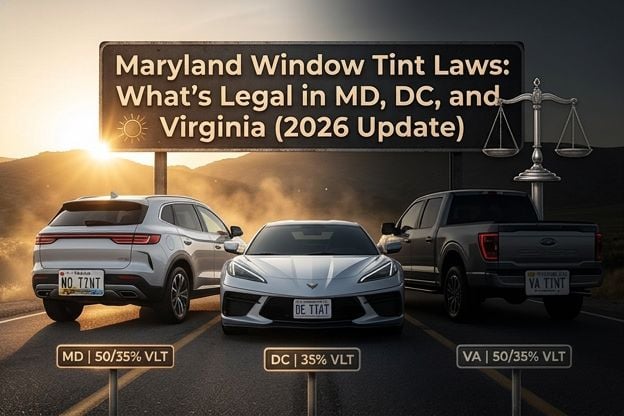
According to Maryland law, front side windows must allow more than 35% of visible light to pass through the combination of film and glass. This is referred to as a 35% VLT limit. Rear side windows and the rear window have more lenient rules on non-passenger vehicles, but passenger vehicles must also comply with the 35% VLT limit. The law also restricts the use of reflective tints, and the reflectivity of the film cannot exceed that of a standard window.
In Maryland, if you want to use a tint darker than the factory standard on your rear windows, you must have dual side mirrors. If your vehicle didn’t come with them, you’ll need to make some modifications. A certified installer can help you understand what’s legal for your specific vehicle class before any film is applied to the glass.
Window Tint Inspection Requirements in Virginia
The annual safety inspection in Virginia includes a check of window tint. Front side windows must allow a minimum of 50% VLT, a more stringent standard than Maryland’s 35%. Rear windows and the rear windshield can have darker tint, but any film on the front side windows must meet that 50% threshold during inspection or the vehicle will not pass. This often catches drivers off guard who had tint installed in a different state or who bought a used vehicle without knowing what film was already on it. If you’re not sure about the VLT of your current tint, a professional installer can measure it before you find yourself in an inspection lane.
Why Heat Rejection is a Necessity in DC’s Climate
Washington DC is one of the East Coast’s most consistently hot and humid metropolitan areas. In the summer, temperatures often rise to the low-to-mid 90s, with the heat index often exceeding 100°F on the hottest days. When you consider the urban heat island effect — the heat radiated by concrete, asphalt, and heavy traffic — the interior of a car parked in DC can heat up to over 150°F within an hour on a sunny summer day.
It’s not just about comfort. The constant exposure to high temperatures speeds up the wear and tear of everything inside your car — from the adhesives and plastics to the leather, vinyl, and electronic components. All these materials will not last as long when they are frequently subjected to extreme heat. Window tint that effectively reduces infrared heat is not just a luxury in this kind of weather. It’s a way to protect your investment.
Jurisdiction Front Side Windows (VLT) Rear Side Windows (VLT) Rear Windshield (VLT) Maryland 35% or more 35% or more (passenger) 35% or more (passenger) Virginia 50% or more Any darkness allowed Any darkness allowed Washington DC 70% or more 50% or more 50% or more
Always confirm current regulations with a certified installer before choosing your VLT level. Laws can be updated, and your specific vehicle class — sedan, SUV, truck, or commercial vehicle — may be subject to different thresholds within the same jurisdiction.
Why the Scorching Summers in DMV Make Ceramic Tint Worth the Additional Cost
When you add the DMV’s sweltering summer heat, long daily drives, and the stop-and-go nature of Beltway and I-95 traffic, the performance difference between carbon and ceramic tint becomes practical rather than just theoretical. Carbon tint will make your car noticeably more comfortable than no tint at all. Ceramic tint — particularly a high-performance film like UVIron — takes that a step further by actively reflecting the infrared radiation that drives cabin temperatures up, keeping your interior cooler from the moment you get in, and reducing how hard your A/C has to work throughout the drive.
Why Choose The Car Shop / Our Unique Selling Points
There are plenty of places in the DMV that can tint your windows. But what makes us different is what happens between the time you make your booking and the time you drive away — the quality of the film we use, the precision with which we install it, the warranty we offer, and the clarity of our pricing. At The Car Shop in Laurel, MD, these aren’t extras. They’re what we do.
UVIron Ceramic Film and Lifetime Warranty Protection
At The Car Shop, we use UVIron ceramic film for our ceramic tint installations. This isn’t a random choice. UVIron is a top-tier ceramic window film that provides the nano-ceramic particle density and optical clarity that sets true ceramic performance apart from cheap products that only use the name. All of our ceramic tint installations come with a lifetime warranty that covers peeling, bubbling, delamination, and color shift. This isn’t just a marketing gimmick—it’s a written guarantee for a film that’s designed to last as long as your vehicle does.
Open and Honest Pricing
The Car Shop believes in providing all-inclusive pricing. The price you’re quoted is the price you pay, with no hidden fees or add-ons at the end of your appointment. This includes edge sealing and removal of existing film. This is how The Car Shop operates across all services, from paint correction and ceramic coating to car audio and electronics. You’ll know what you’re paying before the work even begins.
Serving Laurel, Bowie, Columbia, Silver Spring, and the Broader DMV
At The Car Shop, located at 10075B N 2nd St, Laurel, MD 20723, we are in a prime location for drivers from all over Prince George’s County, Howard County, Montgomery County, and Northern Virginia. We often see customers from Bowie, Columbia, Silver Spring, Rockville, Alexandria, and across DC who want their installations done correctly the first time. Learn more about our services by visiting our welcome page.
Each of our window tint installers are industry-certified in their field. They’ve undergone training that meets professional installation standards for tint and surface protection. This is the same level of training that’s required for PPF installations using 3M and Expel materials, and for wrap work certified through the Wrap Institute and Humble Finish Academy. When you trust us with your vehicle, you’re not handing it over to someone who’s still learning the ropes.
Conclusion & Call to Action
When comparing ceramic and carbon tint, the decision is clear: carbon tint is a strong, cost-effective upgrade that outperforms basic films in every important category, while ceramic tint is the higher-performing, longer-lasting option that is the best choice for drivers who prioritize heat rejection, signal clarity, interior preservation, and a lifetime warranty behind the product. For DMV drivers dealing with intense summers, heavy commutes, and strict jurisdiction-specific tint laws in Maryland, Virginia, and DC, getting this decision right matters — and it starts with a professional installation using film that’s built to last. Ready to get your windows done the right way? Book your appointment at The Car Shop — visit thecarshopmd.com/book-now or call (240) 929-7704. Walk-ins welcome when availability allows.
Common Questions
Is it worth it to pay more for ceramic tint over carbon tint?
If you are planning to keep your vehicle for a long period of time, if you often drive in hot weather, or if you want the best heat rejection and interior protection available, then ceramic tint is worth the extra cost. The difference in performance is not just a marketing ploy – it’s real and it’s measurable.
- Ceramic rejects 60–80%+ of infrared heat vs. carbon’s 40–50%
- Ceramic carries a lifetime warranty at The Car Shop; carbon warranty terms vary by product
- Ceramic is 100% signal-transparent — no GPS, Bluetooth, or toll transponder interference
- Both block up to 99% UV, but ceramic also addresses infrared heat that UV ratings don’t capture
- Carbon is the right call when budget is the primary constraint and performance is still a priority over basic dyed film
The honest answer is that ceramic tint pays for itself over time through reduced A/C load, better interior preservation, and a film that doesn’t need to be replaced. For a vehicle you’re keeping long-term, the math favors ceramic.
Carbon tint is far from a poor choice. It’s a solid middle-of-the-road product that far surpasses dyed films. But when you stack it up against ceramic and money isn’t the deciding factor, ceramic comes out on top in every performance category that matters in everyday DMV driving.
The most effective method to settle on a choice is to talk about your particular vehicle, your driving habits, and your requirements with a certified installer who can give you precise data — not only a broad recommendation. That is precisely the conversation that The Car Shop’s team is prepared to have with you before any film is applied to your windows.
Can carbon tint disrupt GPS or cell phone signals?
Carbon tint does not contain metal, so it does not have the same signal-blocking issues that older metalized films do. In most cases, under normal conditions, carbon tint will not noticeably interfere with GPS or cell phone signals. However, in areas with low coverage or weak signals, there may be slight variations — especially with GPS logging devices and dash cameras that need a steady satellite connection.
Tint Type Signal Interference Risk GPS Impact Best For Electronics? Dyed Film Low (non-metallic) Minimal Acceptable Metalized Film High Significant drops No Carbon Tint Low to minimal Occasional minor drops Generally yes Ceramic Tint None Zero interference Yes — completely safe
If your vehicle has integrated ADAS features, telematics systems, or factory-installed GPS that communicate through the glass, ceramic tint is the only choice that guarantees zero interference. Carbon tint is fine for most standard vehicles but introduces a variable that ceramic eliminates entirely.
If you’re a driver who uses toll transponders such as E-ZPass that are mounted on your windshield, or if you depend on Bluetooth audio streaming and real-time navigation for your job, you’ll find the total signal transparency of ceramic tint to be a practical benefit in your daily life, not just a feature on a spec sheet.
What are the legal tint limits in Maryland and Virginia?
In Maryland, the law requires that front side windows must allow at least 35% of visible light transmission (VLT), which is the combined light that passes through the film and the glass. In Virginia, the law is more strict and requires that front side windows must allow at least 50% of VLT, which is checked during the state’s annual safety inspection. Washington DC requires that front side windows must allow at least 70% of VLT, with rear side windows and the rear windshield allowing at least 50% of VLT. These limits apply to passenger vehicles, but commercial vehicles and SUVs may have different allowances depending on the jurisdiction. Always make sure to confirm the legal VLT for your specific vehicle class with a certified installer before choosing your darkness level.
What is the lifespan of ceramic window tint?
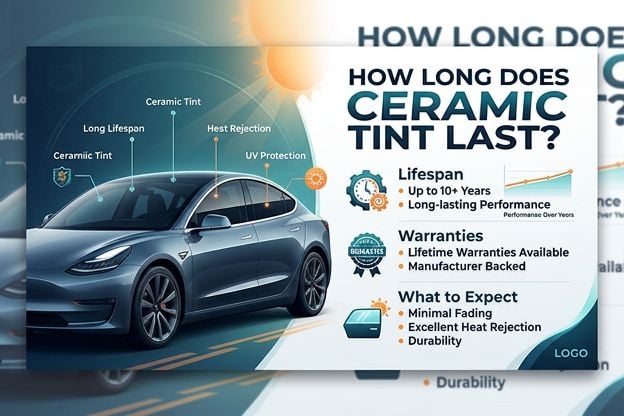
Top-notch ceramic window tint — professionally applied using a film such as UVIron — is engineered to last as long as the vehicle without peeling, bubbling, delaminating, or changing color. Its nano-ceramic makeup is naturally more stable than carbon or dyed films when exposed to UV rays and heat for extended periods, which is why high-quality ceramic products can offer lifetime warranties that lower-quality films can’t.
How long any tint film lasts is also greatly affected by the quality of the installation. If the film is applied without properly preparing the surface, using the wrong squeegee technique, or not sealing the edges well, it will not last as long no matter how good the original material is. The rated lifespan of the film can only be achieved in reality if it is installed correctly by a certified professional using the right tools and methods.
With professional installation, carbon tint usually lasts between 5 and 10 years before it starts to fade or change color, depending on how much sun exposure it gets and what the weather conditions are like. In the hot summer weather of the DMV region, this timeline can be shorter for films that are exposed to direct southern or western sun for many hours each day. Ceramic is more stable under these conditions, which is part of why it’s covered by a warranty.
Is same-day window tinting available at The Car Shop in Laurel, MD?
Depending on the current schedule and the specific needs of your vehicle, The Car Shop may be able to install your window tint on the same day. Most standard window tinting jobs — including the front and rear side windows and the rear windshield — can be finished in just a few hours. To make sure you can get your window tint installed when you want it, especially during the busy spring and summer months, it’s best to book an appointment in advance at thecarshopmd.com/book-now.
We’re happy to accommodate walk-ins whenever we can. If you’re driving in from Bowie, Columbia, Silver Spring, Northern Virginia, or DC, we recommend giving us a call at (240) 929-7704 to check for same-day availability before you hit the road.
At The Car Shop, located at 10075B N 2nd St, Laurel, MD 20723, our certified team can handle everything from vehicle-specific VLT consultations to legal compliance checks to installation — all under one roof. If you’re not sure whether carbon or ceramic is the right fit for your vehicle, we can have that conversation before any work starts, free of charge. The Car Shop is the DMV’s trusted automotive customization center, ready to help you protect your vehicle with a professional-grade tint solution that’s built to last.

 By
By