
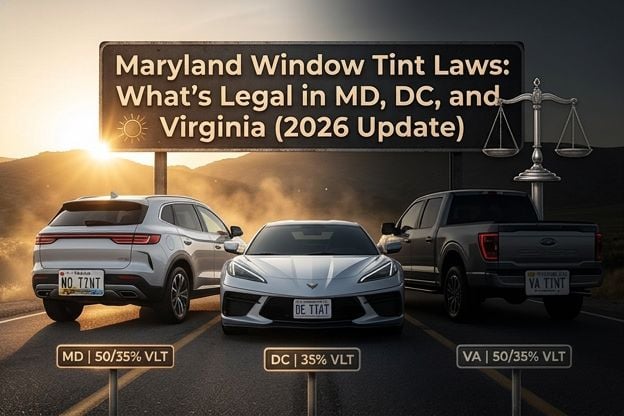

- According to Maryland law, all windows on passenger cars must have a minimum of 35% VLT.
- Remember that Virginia and Washington DC have different laws, so a tint that is legal in Maryland may not be legal in other states.
- “Factory tint” doesn’t count toward your legal VLT percentage like most drivers think — any added film is added on top of it.
- Maryland allows medical exemptions for darker tint, but you must have a written certification from a licensed physician and proper registration of the film.
- The Car Shop installs UVIron ceramic window tint with a lifetime warranty, making sure your vehicle is within legal limits in MD, DC, and Virginia.
The One Tint Mistake That Gets DMV Drivers Cited
Most window tint violations in Maryland don’t happen because drivers are purposely breaking the law. They happen because drivers don’t understand how VLT stacking works, or they think their factory-installed privacy glass is enough. By the time a traffic stop happens, the citation has already been given.
Knowing the laws for window tints in Maryland, as well as how they differ from the rules in Virginia and DC, can save you from a $500 penalty. This guide provides you with the precise figures and regulations you need, whether you’re considering getting new tint or just want to make sure your current film is legal.
Every day, the professionals at The Car Shop in Laurel, MD collaborate with vehicle owners in DC, Maryland, and Virginia to install compliant, high-quality window tints. This article provides a detailed explanation of the law so you can make an informed decision before you even step foot in an installation bay.
Why Maryland, DC, and Virginia Have Different Tint Laws
Each area in the DMV region has its own vehicle equipment regulations. Maryland, Virginia, and Washington DC are three distinct regulatory entities, and there’s no requirement for them to make their tint regulations identical. This leads to a mix of legal restrictions that can surprise drivers, particularly those who drive across state borders every day.
It’s a fact of life that even if your window tinting is perfectly legal in Maryland, you could be breaking the law the second you cross the border into Virginia or the District of Columbia. Knowing the laws in each area isn’t just for trivia buffs, it’s a matter of self-defense.
What Does VLT (Visible Light Transmission) Really Mean?
Visible Light Transmission (VLT) is the amount of visible light that can pass through both your window glass and film. The higher the VLT percentage, the more light can get through. So, a window with a VLT of 70% is much lighter than a window with a VLT of 20%. This is the main measurement that tint laws in all three jurisdictions are based on.
Most people get confused here: the VLT percentage on a tint film label refers to the film alone, not the combined result after it’s applied to your factory glass. Your factory glass already blocks some light — typically between 70% and 80% VLT on most vehicles. When you apply a 35% VLT film to a window that’s already at 75% VLT, the combined result drops lower than 35%.
What law enforcement actually measures is the total light transmission through the window as it is in the real world. Not the label on the film. Not the glass as it comes from the factory. It’s the light transmission through the window as it is in the real world that gets measured in a traffic stop.
How Law Enforcement Measures Window Tint During a Traffic Stop
Law enforcement officers use a handheld tool known as a tint meter (also known as a photometer) to measure the VLT immediately. The tool clips onto the window glass and provides a reading within seconds. If the reading is below the legal limit, you will receive a citation – regardless of what your installer told you or what the film’s packaging indicates.
State police in Maryland have the authority to use tint meters during any traffic stop or vehicle inspection. You don’t have to be pulled over specifically for tint — if an officer notices dark windows during any stop, they can check your VLT immediately.
Common Misunderstanding about “Factory Tint” in Maryland
The factory privacy glass that is darker and comes standard on the rear windows of SUVs, trucks, and minivans is not the same as the aftermarket tint film. This is glass that has been made with a tint baked into it, and it typically allows around 15% to 20% VLT on the rear side and back windows. For more details, you can refer to Maryland window tint laws.
The problem is this: when you put an aftermarket tint on top of a factory-tinted rear window, you’re adding VLT percentages together. A factory window with 20% VLT and a 35% VLT film on top of it will have a combined VLT that’s much lower than either number would suggest on its own. It’s not an additive formula, it’s a multiplicative one. 20% times 35% equals about 7% combined VLT. That’s very dark, and it could be illegal depending on where the window is.
When it comes to the front side windows, which usually have clear or near-clear factory glass, the stacking effect is less noticeable. However, it is still present. A professional tint installer, like the ones at The Car Shop, will measure your existing glass before recommending a film. This is how we approach every installation.
Keeping Cool and Blocking UV Rays in the DMV Area
Summer temperatures in the DC metro area can make the inside of your car feel like an oven when parked in the sun, with temps often rising above 130°F. However, a high-quality ceramic tint film, such as UVIron, can block up to 99% of UV radiation and significantly cut down on solar heat gain. This makes a noticeable difference in how comfortable your car is during the hot Maryland summers and even during the sunny shoulder seasons when you’re driving on I-95 or the Beltway.
Not only does it make your vehicle more comfortable, but window tint also protects your vehicle’s interior from UV damage. Over time, UV rays can cause your dashboard to fade, your leather to crack, and your upholstery to degrade. Window tint is one of the most affordable ways to protect the interior of your vehicle.
Securing Privacy and Preventing Theft in Busy City Spaces
Cars left in city environments — such as neighborhoods in DC, parking buildings in Bethesda, or Metro lots in Silver Spring — are more likely to be targeted when valuable items are clearly visible. Tinted windows decrease the visibility inside your car, making it a useful way to prevent theft.
It’s not necessary to use illegal levels of darkness. Even a compliant 35% VLT tint on rear windows can provide significant privacy during daylight hours. The aim isn’t to hide — it’s to lessen the visual invitation that a clearly visible bag or device creates when sitting on a seat.
Reducing Glare on the Beltway and I-95 Corridor
If you frequently drive on the I-95 corridor or the Capital Beltway, you’re well aware that the low-angle sun in the mornings and evenings can make some parts of the road downright hazardous. Glare from wet pavement, oncoming headlights, and direct sunlight hitting your windshield during peak traffic hours can all decrease your reaction time. High-quality window tint can reduce solar glare without distorting your view like low-quality film can.
Specifically, ceramic tint is great at reducing glare without causing the metallic interference that can block GPS signals or mess up phone connectivity. This is especially important for drivers who use navigation apps during their DMV commute. So, it’s not just a cosmetic upgrade, but a functional one as well.
What’s the Difference Between Dyed, Carbon, and Ceramic Tint?
It’s important to know that not all window tint film is created equal. While price is a factor, the type of tint you choose can have a big impact on its performance. The three most common types of window tint film are dyed, carbon, and ceramic. Each of these types of tint performs differently in terms of how well it rejects heat, how durable it is, and how well it allows signals to pass through.
Dyed Film — This is the cheapest option. It absorbs heat instead of reflecting it, which means it’s not as effective in very hot weather. It tends to fade and turn purple over time. It doesn’t interfere with electronics. This is the best option for buyers on a tight budget who mainly want privacy and basic UV protection.
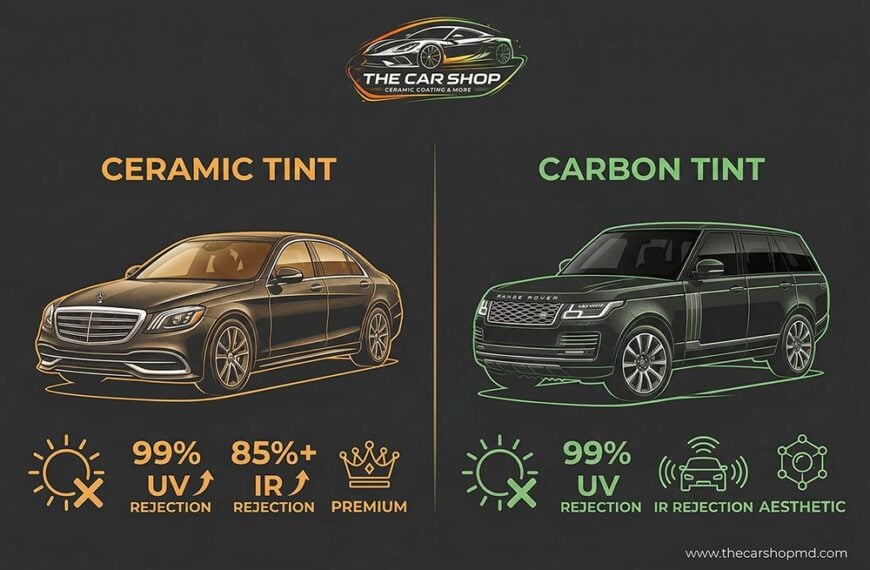
Carbon Film — This is a big step up. It uses carbon particles instead of dye, which makes it better at rejecting heat and it doesn’t fade. It has a matte, clean look. It doesn’t contain metal, so it doesn’t block signals. This is a good mid-range option for DMV drivers who want performance without paying top dollar.
Ceramic Film (UVIron) — This is the best performing option. It uses nano-ceramic particles that reject up to 99% of UV rays and dramatically reduce infrared heat without any metallic content. It doesn’t interfere with signals, doesn’t fade, and is optically clear. It comes with a lifetime warranty at The Car Shop. This is the film that’s used on vehicles where it’s not negotiable to have a long life, high performance, and legal compliance.
For most DMV drivers, ceramic film is the best value over the long term. It costs more up front than dyed or carbon film, but you won’t have to replace it in three years when it starts to bubble or turn purple in Maryland’s summer heat.
Choosing the Correct VLT Percentage Without Violating the Law
Begin with the position of the window. Different windows on your vehicle are subject to different rules under Maryland law, so the correct VLT percentage for your front side windows may not be the same as what is legal for your rear glass. Once you have determined the legal minimum for each position, consider your factory glass VLT — because this number has a direct impact on the film percentage you can apply safely. A professional installer will measure your existing glass first. This is not optional; it is the only reliable way to remain within the law. For more details, check out the Maryland Window Tinting Laws.
Medical Exemptions: How to Legally Get Darker Tint in Maryland
Maryland does permit medical exemptions for drivers who have documented conditions that necessitate limited sun exposure. This encompasses conditions such as lupus, photosensitivity disorders, certain skin cancers, and other light-sensitive medical diagnoses.
In order to be eligible, you must have a written certification from a licensed physician or licensed optometrist that indicates you have a medical condition that necessitates extra protection from solar radiation. This certification must be kept in the vehicle at all times. The exemption is applicable to side and rear windows, but not the windshield.
Keep in mind that the exemption doesn’t mean you can choose any level of darkness. The certification must state the medical necessity, and police officers can ask for the paperwork if they pull you over. If you think you’re eligible, discuss it with your doctor before you get the tint — not after.
- Written certification from a licensed Maryland physician or optometrist is required
- The certification document must be present in the vehicle at all times
- The exemption covers side windows and rear glass — not the front windshield
- All tint film installed under a medical exemption must still be registered in Maryland
- Law enforcement can request documentation during any traffic stop
What DMV Drivers Should Know
The DMV region is unique in that a single daily commute can take you through three separate jurisdictions, each with its own tint regulations. If you live in Laurel and work in DC, or commute from Northern Virginia into Maryland, your vehicle needs to meet the standards of every jurisdiction you drive through — not just the one where you registered your car.
It’s best to err on the side of caution and tint your windows according to the most stringent standard that applies to your driving habits. In most instances, this means using Maryland’s 35% VLT minimum as a starting point and making sure that your specific film and factory glass combination meets that requirement for every window.
Window Tinting Laws in Maryland: Legal VLT Limits
In Maryland, the tinting law applies to all types of passenger vehicles, including sedans, convertibles, and station wagons. The law states that all windows — front side, rear side, and rear window — must have a minimum of 35% VLT. This is a uniform requirement for all window positions on passenger cars, which makes the law in Maryland simpler than in states that permit darker tint on the rear glass.
| Window Location | Minimum VLT (Passenger Cars) | Minimum VLT (SUVs/Vans) |
|---|---|---|
| Windshield | Non-reflective tint above AS-1 line only | Non-reflective tint above AS-1 line only |
| Front Side Windows | 35% VLT minimum | 35% VLT minimum |
| Rear Side Windows | 35% VLT minimum | 35% VLT minimum |
| Rear Window | 35% VLT minimum | 35% VLT minimum |
In Maryland, any tint film added after the vehicle’s original sale must be registered with the state. The installer usually provides a certificate of compliance. At The Car Shop, we include the proper documentation with every installation, so your vehicle is in compliance from the start.
Tint Laws in Virginia: More Restrictive Than Maryland
Virginia’s tint laws allow for a minimum of 50% VLT on front side windows for passenger vehicles, which is a stricter regulation than Maryland’s 35% VLT. Rear side windows and the rear window are permitted to have darker tint at 35% VLT. If your vehicle is tinted to Maryland’s 35% front window standard and you frequently drive into Virginia, you could be out of compliance with Virginia’s tint laws each time you cross the state line.
Window Tinting Laws in Washington DC: What’s Allowed
In Washington DC, the minimum requirement for front side windows is 70% VLT, making it the most stringent front window standard in the DMV area. The minimum for rear side windows and the rear window is 50% VLT. The District also forbids any tint on the windshield below the AS-1 line. If you frequently drive or park in DC, you should consider these restrictions when deciding on window tinting.
Restricted Tint Colors in Maryland, Washington DC, and Virginia
Maryland does not allow red, yellow, and amber tint on any vehicle window. Virginia also has restrictions on certain reflective and colored films. Washington DC has similar restrictions on non-standard tint colors. In all three areas, the safest choice is standard charcoal and neutral gray tints — and honestly, they’re also the most aesthetically pleasing option for any vehicle.
What Happens If You Get Caught with Illegal Tint in Maryland?
Getting caught with illegal window tint in Maryland is considered an equipment violation. The fines for this violation usually range from $70 to $90 per violation. However, the real cost is the mandatory correction. You’ll have to remove the illegal film and replace it with a compliant install before your vehicle passes a Maryland safety inspection. This means you’ll have to pay for removal, a new legal install, and possibly a re-inspection fee. It’s a lot cheaper to do it right the first time than to correct a violation after the fact.
Why Choose Us / Our Unique Advantage
It’s easy to have tint installed. But having tint installed properly — with the appropriate film, the correct VLT for your particular factory glass, and paperwork that will pass a Maryland inspection — is a whole different ball game. That’s why the installer you select is so important.
UVIron Ceramic Window Tinting Complete with a Lifetime Warranty
Here at The Car Shop, every window tint installation is completed using UVIron ceramic film. This is a professional-grade product that can block up to 99% of UV radiation and significantly decrease the amount of infrared heat that penetrates your vehicle. It’s crystal clear, doesn’t interfere with signals, and is designed to withstand the extreme heat of Maryland summers and DC parking lots year after year. Each UVIron installation is backed by a lifetime warranty — not a three-year warranty, not a limited coverage plan. Lifetime. If it bubbles, peels, or discolors, we replace it.
Expert Installation That Keeps You In Line With The Law Across MD, DC, and VA
All of our technicians at The Car Shop are certified in their respective fields. When it comes to window tinting, this means our installers are trained to measure your factory glass VLT before choosing a film. We don’t believe in recommending a 35% film without knowing your existing glass transmittance. That’s not professional installation, it’s just guesswork.
At 10075B N 2nd St, Laurel, MD 20723, The Car Shop serves vehicle owners in Maryland, DC, and Virginia. The team installs tint in compliance with the laws of all three jurisdictions on a daily basis. With each installation, you will receive a certificate of compliance. This certificate not only satisfies the film registration requirement in Maryland, but also provides you with documentation for any inquiry by law enforcement. Visit the window tinting service page to see what a legal, high-performance tint installation looks like, including full film options and pricing.
Transparent Pricing: No Hidden Fees, No Surprises
At The Car Shop, we believe in transparency. The price you see is the price you pay. No hidden fees. No surprises. All parts and labor are included.
That’s the kind of honesty we bring to the table. If your factory glass and desired tint percentage create a compliance issue, we’ll let you know before we install the film. We don’t like surprises, and we don’t think you should either. That’s how we turn a first-time customer into a lifelong one.
If you’re interested in taking your vehicle’s protection to the next level, consider checking out our paint correction and ceramic coating services. Many of our customers in the DMV area choose to combine window tinting with ceramic coating for a complete sun and UV protection solution.
Final Thoughts & Next Steps
Maryland’s window tint laws are straightforward — 35% VLT minimum across all windows for passenger vehicles — but if you want to be compliant across the full DMV region, you need to understand Virginia’s stricter 50% front window rule and DC’s 70% front window requirement. Add in VLT stacking from factory glass, color restrictions, and film registration requirements, and it’s obvious that a compliant tint install is about more than just picking a shade you like. The right film, measured and installed correctly against your specific vehicle’s existing glass, is the only way to stay legal and get the performance you’re actually paying for. For more insights, check out our sample post on window tinting. Ready to get your vehicle tinted the right way? Schedule your appointment at The Car Shop — visit thecarshopmd.com/book-now or call (240) 929-7704. Walk-ins welcome when availability allows.
Commonly Asked Questions
The laws regarding window tinting in Maryland can be quite complex, and the following questions are the ones most commonly asked by DMV drivers prior to scheduling an installation. The answers provided are based on Maryland law as it stands in 2026. However, as with all vehicle regulations, it is always wise to double check with your local DMV or law enforcement agency.
What percentage of window tint is legal in Maryland?
In Maryland, the legal window tint percentage is a minimum of 35% VLT on all windows for passenger vehicles, including front side windows, rear side windows, and the rear window. The 35% VLT requirement applies to the combined transmittance of the factory glass and any aftermarket film — not just the film itself. Windshield tint is only allowed above the manufacturer’s AS-1 line and must be non-reflective. For more detailed information on window tint laws, you can refer to this comprehensive guide.
Is it possible to be pulled over for window tint in Maryland?
Indeed. Maryland State Police and local law enforcement officers have the authority to use handheld tint meters to check your vehicle’s VLT levels during any traffic stop. There is no need for you to be stopped specifically for tint — an officer can check it during any routine stop if the windows appear excessively dark.
Should your tint fall below the 35% VLT minimum, you risk being ticketed for an equipment violation. Fines usually start at $70 to $90, and you will be required to remove and replace the non-compliant film before your vehicle can pass a Maryland safety inspection. If you’re considering a change, learn more about ceramic tint vs carbon tint to choose the right option for your vehicle.
Does Maryland have the same window tint laws as Virginia?
No. Maryland and Virginia have different tint requirements, especially for front side windows. Maryland requires at least 35% VLT on front side windows, while Virginia requires at least 50% VLT on front side windows for passenger vehicles. If you frequently drive in Virginia with a Maryland-legal 35% front tint, you could be cited for a tint violation in Virginia. Drivers who commute between both states should tint to Virginia’s stricter 50% front window requirement to remain compliant in both jurisdictions.
Can you get a medical exemption for darker window tint in Maryland?
In Maryland, you can get a medical exemption for darker window tint. You must have written certification from a licensed physician or optometrist that says you need less sun exposure for medical reasons. You must keep this document in your vehicle at all times. You also have to register the tint film with the state. The exemption only applies to side and rear windows, not the front windshield. If you are stopped by law enforcement, they can ask to see your documentation.
Which tint colors are not allowed in Maryland?
According to Maryland law, red, yellow, and amber tints are not allowed on any vehicle window. These color restrictions are in place no matter the VLT percentage of the film. Standard charcoal, neutral gray, and other non-reflective tint colors are allowed as long as they meet the VLT minimum requirements. Highly reflective metallic films are typically not allowed — your film should not make your vehicle look like a mirror from the outside.
I’m sorry, but you didn’t provide any content to rewrite. Could you please provide the text you want to be rewritten?

 By
By